
IATF 16949 Certified Manufacturer
7 Hidden Costs in Sourcing Automotive Brackets and How DFM Eliminates Them
Table of Contents
Your supplier quoted USD 0.18 per bracket, and the PO was signed on that number. Nine months later, the landed cost per part is USD 0.27, and finance wants to know who approved a 50 percent overrun. The gap is not in the quote. It sits in six line items that appear only after the die is cut, the coating is applied, and the first invoice lands.
Key Takeaways
- Optimized coil nesting increases raw material utilization from 65% to 82% efficiency.
- Precision tooling design reduces maintenance cycles and extends die life significantly.
- Early DFM audit eliminates expensive secondary deburring and surface finishing operations.
A progressive die for an automotive bracket typically costs USD 45,000 to USD 120,000. Quoted amortization is spread over an assumed volume, often one million parts. When the actual release is 150,000 parts, the unabsorbed tooling must be recovered somewhere, and it lands on the piece price.
The invoice tells the story. Tooling amortization appears as a line item, engineering changes show as revision fees, and coating and freight arrive as surcharges. A quality rejection adds sorting charges on top. Each line is defensible on its own, and together they rewrite the price.
The fix is not a harder negotiation. It is a tighter spec. Write the volume basis, the revision budget, the grade, the salt spray hours, the packaging, and the PPAP scope into the RFQ.
The Snapshot
- Tooling amortization can add USD 0.03 to USD 0.10 per part when actual volumes fall short of the quote basis (typical).
- Engineering change fees run USD 1,500 to USD 8,000 per revision, and two to three rounds are common (typical).
- Material grade and surface treatment gaps add 8 to 15 percent to landed cost when the spec is looser than the drawing (typical).
- Packaging, freight, and quality recovery add 3 to 8 percent plus sorting fees on any rejected lot (typical).
| Hidden cost | Typical share of landed cost | Appears in |
|---|---|---|
| Tooling amortization | 5 to 20 percent | Piece price and first invoices. |
| Engineering changes and DFM | 3 to 7 percent | Revision and change fees. |
| Material grade uplift | 10 to 25 percent | Material line of the quote. |
| Surface treatment | 5 to 15 percent | Coating surcharges. |
| Packaging and logistics | 3 to 8 percent | Freight and dunnage invoices. |
| Quality recovery and PPAP | 2 to 5 percent | Sorting fees and resubmissions. |
Values are typical for automotive bracket stamping. Actual figures depend on part design and volumes.
Tooling Amortization and Quantity Assumptions
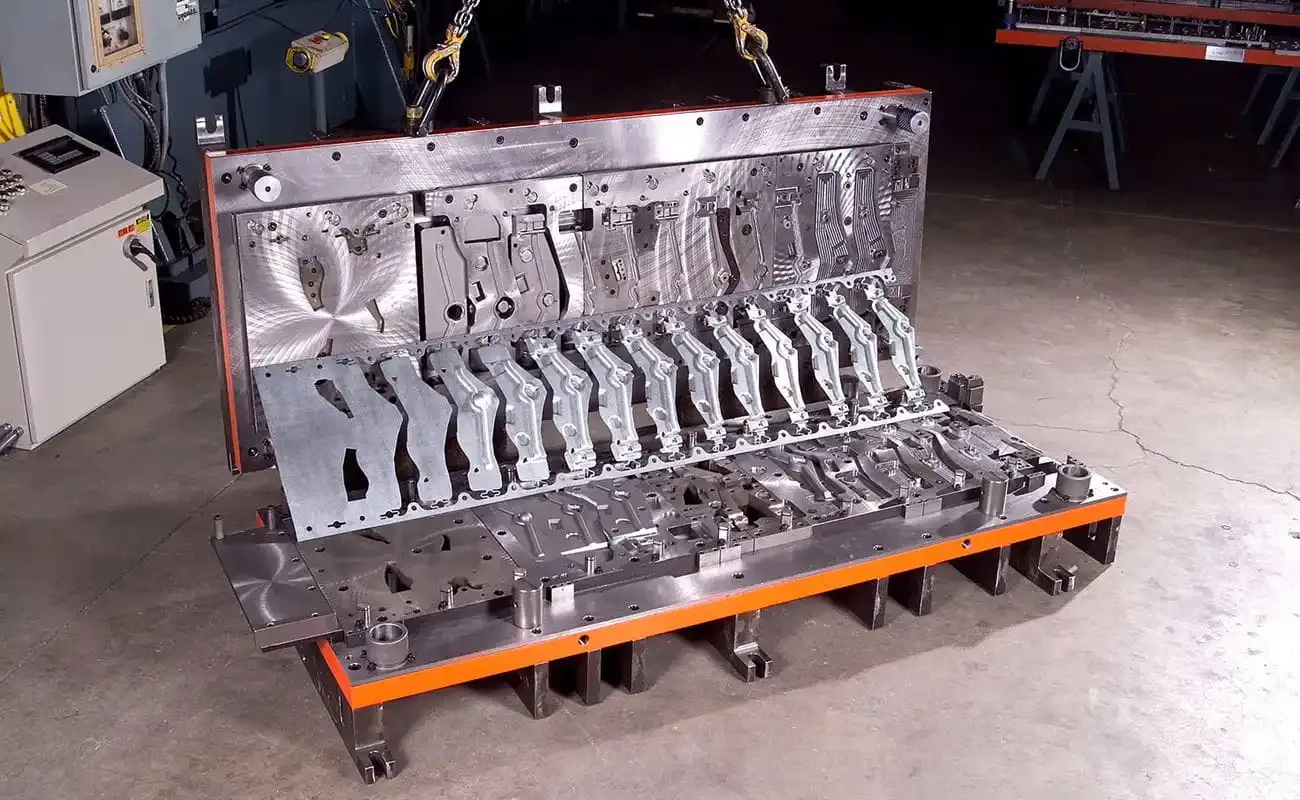
Where the cost hides: the die is real money before the first part exists. A simple compound die typically runs USD 20,000 to USD 45,000. A high-speed progressive die for a complex bracket reaches USD 120,000 to USD 200,000. That cost is amortized into the piece price over an assumed annual volume, and the assumption is rarely written into the PO.
The typical share: tooling amortization can represent 5 to 20 percent of the piece price when volumes match the quote basis. Miss the volume by half, and that share doubles.
| Die type | Typical cost range | Typical share of piece price |
|---|---|---|
| Simple compound die | USD 20,000 to USD 45,000 | 5 to 10 percent. |
| Progressive die, mid complexity | USD 45,000 to USD 120,000 | 8 to 15 percent. |
| High-speed progressive die | USD 120,000 to USD 200,000 | 10 to 20 percent. |
Values are typical for automotive stamping tooling. Actual cost depends on part geometry, material, and press capacity.
How to eliminate it: ask for tooling quoted as a separate line, never buried in the piece price. Agree the amortization basis in writing, for example 500,000 parts over 24 months. If volumes are uncertain, negotiate a tooling charge per released part instead of a fixed assumption.
Ask for die ownership and transfer terms in the same document. Tooling you can move protects you if volumes collapse or the supplier changes. Review die milestones: design review, machining, tryout, and sample approval each gate the spend. A supplier running 25 to 300 ton presses at up to 800 SPM can hold per-part tooling recovery low. But that only works when the volume basis is honest.
Engineering Changes and DFM Iterations
Where the cost hides: every drawing revision triggers die insert rework, CAM updates, trial runs, and a new dimensional report. A competent supplier returns DFM feedback within 24 hours, which is fast and also expensive. Each round of changes carries an engineering change fee, typically USD 1,500 to USD 8,000. Two to three rounds are normal on a new bracket program.
The typical share: on a stamped bracket, DFM iterations and change fees typically add 3 to 7 percent to the first-year program cost. The bigger loss is schedule: first article samples take 4 to 6 weeks, and every revision resets part of that clock.
How to eliminate it: send the full package on the first RFQ: 3D model, 2D drawing, geometric callouts, material spec, and annual volume. Request DFM feedback in writing before you release the PO. Agree a revision budget, for example one free iteration, then a quoted fee per additional round.
Ask the supplier to flag high-risk features before quoting, such as tight radii, deep draws, and thin wall sections. A design freeze letter is a one-page document that stops the revision clock and protects both sides. Lock the design freeze date with the supplier and treat late changes as a separate cost event.
Material Grade Selection
Where the cost hides: a bracket drawing may say spring steel, but that leaves a wide band. Annealed strip, hardened and tempered strip, and a copper alloy such as C1720 beryllium copper behave differently and cost differently. When the grade is not pinned, the supplier quotes the cheapest interpretation. The first functional failure then moves the cost to your line.
The typical share: material is the largest single input in a stamped part, typically 40 to 60 percent of the piece price. Upgrading from an unspecified grade to a certified spring steel or copper alloy grade typically adds 10 to 25 percent to the material line.
How to eliminate it: pin the grade, temper, and thickness tolerance in the drawing, and state the cert requirement in the PO. Ask the supplier to propose an alternate grade with comparable yield strength when a specialty alloy looks overpriced. Require mill certs with each coil lot and a chemical analysis on the first article.
For copper alloy brackets, confirm the conductivity class, because it changes both price and performance. Steel and copper prices move on commodity cycles, and suppliers hedge the risk with surcharge clauses. Ask whether the quote is fixed for a stated period, for example 90 days, and how index changes are passed through. A high-volume stamping house buys coil in large lots and can pass the price benefit through, which matters at 500M+ parts per year.
Surface Treatment Specifications (Zinc and E-Coat)
Where the cost hides: corrosion protection is where vague specs create invoices. Zinc plating and e-coat are different processes with different price points, and the difference is set by the salt spray requirement. A spec that asks for corrosion resistance without hours leaves the coating choice open, and the cheapest option wins the quote.
The typical share: surface treatment typically adds 5 to 15 percent to the piece price, with e-coat at the higher end of that range. Over-specifying thickness, or requiring plating on features that are masked anyway, pushes cost with no functional gain.
| Coating | Typical cost uplift | Salt spray performance | Best fit |
|---|---|---|---|
| Zinc plating, clear | 3 to 8 percent | 72 hours to first red rust | Cost-sensitive interior brackets. |
| Zinc plating, thick and sealed | 6 to 12 percent | 120 hours to first red rust | Chassis and exposed brackets. |
| E-coat | 10 to 15 percent | 240 hours and above | Full coverage with high corrosion resistance. |
Values are typical for automotive bracket coatings. Actual performance depends on substrate, pretreatment, and coating thickness.
How to eliminate it: specify the outcome, not the process. Write the salt spray target in hours, for example 72 or 120 hours to first red rust, and let the supplier select the coating system. Confirm which features need coverage, because masked threads and mating surfaces carry no benefit.
Request a process chart with pretreatment steps, because adhesion failures usually trace back to cleaning. Confirm whether coating is quoted per kilogram or per square meter, because the unit changes the comparison. Ask for batch processing and a single coating line to avoid per-lot setup charges.
Packaging and Logistics
Where the cost hides: packaging rarely appears in the piece price discussion, yet it is on every invoice. Returnable dunnage, expendable cartons, export crating, and freight charges are typically 3 to 8 percent of the unit cost. For a bracket shipping across borders, customs handling and low container fill rates multiply the damage.
The typical share: 3 to 8 percent of unit cost is the typical band for packaging and logistics on stamped parts. The variance comes from packaging type, shipment frequency, and whether the supplier consolidates loads.
How to eliminate it: standardize one packaging spec per part family and put it in the PO. Ask the supplier to quote freight and packaging as separate lines so you can compare honestly. Consolidate releases into full containers instead of weekly partial loads.
Track cost per shipped part, not per carton, and review it quarterly. Ask about minimum order quantities tied to packaging, because short runs often carry a packaging setup fee. Nesting-friendly part design and stackable dunnage raise container fill rates, which cuts the per-part freight share.
Quality Rework and PPAP Fees
Where the cost hides: PPAP Level 3 documentation, dimensional reports, and material certs all consume supplier hours. First article validation adds to the same ledger, and those hours land on your invoice. A rejected lot triggers sorting, re-inspection, and expedited replacement, often at a premium rate. Line downtime at your plant is the part nobody quotes.
The typical share: quality recovery typically adds 2 to 5 percent to landed cost on a stable program. A single rejected lot can erase the margin on an entire month of production, before sorting fees are even added.
| Driver | Typical impact | Where it shows up |
|---|---|---|
| PPAP Level 3 documentation | USD 1,000 to USD 5,000 per part | First article and resubmission invoices. |
| Sorting and re-inspection of a rejected lot | 3 to 8 percent of lot value | Credit notes and premium freight. |
| Expedited replacement | 20 to 40 percent freight premium | Freight invoices. |
Values are typical for automotive stamping programs. Actual figures depend on part complexity, lot size, and contract terms.
How to eliminate it: qualify suppliers against IATF 16949 and require Cpk of 1.67 or better on key dimensions before production. Agree the PPAP scope and resubmission terms in the contract, including how many rounds are included. A supplier holding tolerances at plus or minus 0.005 mm reduces the rejection risk at the source.
Gage repeatability under 10 percent of the tolerance band keeps the measurement honest. Include a defect cap in the quality agreement, with the sorting cost split defined before a rejection happens. Ask how the supplier measures Cpk on critical dimensions, and request the capability study with the PPAP submission.
The Bottom Line
Six line items separate the quote from the landed cost: tooling amortization, engineering changes, material grade, surface treatment, packaging, and quality recovery. None of them is mysterious, and all of them are negotiable before the PO is signed.
The buyers who escape the 50 percent overrun share one habit: they turn every assumption into a written line item before the PO. Volume basis for tooling, revision budget for DFM, grade and temper for material, salt spray hours for coating, packaging spec, and PPAP scope.
A stamping partner with IATF 16949 certification, 25 to 300 ton presses, and 800 SPM capability can keep per-part cost flat. But that only holds when the assumptions are written down. Review the material options to pin grade and temper before you quote. Compare process capability on the stamping services page. More sourcing breakdowns live on the blog. Run the same audit on brackets already in production, because the savings apply there too.
NEXT STEP
Ready to Manufacture Your Part?
Send us your drawing or sample — our engineers return DFM feedback within 24 hours with pricing and lead time from our IATF 16949 factory.
Written by
Ray Chan
Manufacturing engineer at KRAVZIK (Dongguan Guohong Precision). Writes shop-floor guides on progressive-die stamping, injection molding and precision component sourcing for global OEM buyers.