
Sub-Micron Electropolishing Finishing Solutions
Overcoming inherent mechanical finishing limitations such as microscopic surface peaks and structural burrs on intricate components, we engineer ultra-smooth, mirror-like topographies optimized for high-grade stainless steel alloys. By deploying specialized racking configurations and executing prec…
Overcoming inherent mechanical finishing limitations such as microscopic surface peaks and structural burrs on intricate components, we engineer ultra-smooth, mirror-like topographies optimized for high-grade stainless steel alloys. By deploying specialized racking configurations and executing precise electrolyte formulation management, our chemical processing dissolves surface impurities and microscopic asperities rather than relying on abrasive deformation. Backed by our rigorous IATF 16949-certified quality framework, we guarantee uniform material removal that unlocks medical-grade biocompatibility and maximum corrosion resistance, thereby ensuring absolute passivity and flawless fluid dynamics under the most rigorous global engineering specifications.
Micro-Burr Removal: Eliminate microscopic burrs from internal geometries.Corrosion Resistance: Maximize chemical stability in harsh environments.Biocompatible Surfaces: Perfect for medical and food-grade parts.Mirror-Like Finish: Achieve consistent high-luster and functional clarity.Request DFM Evaluation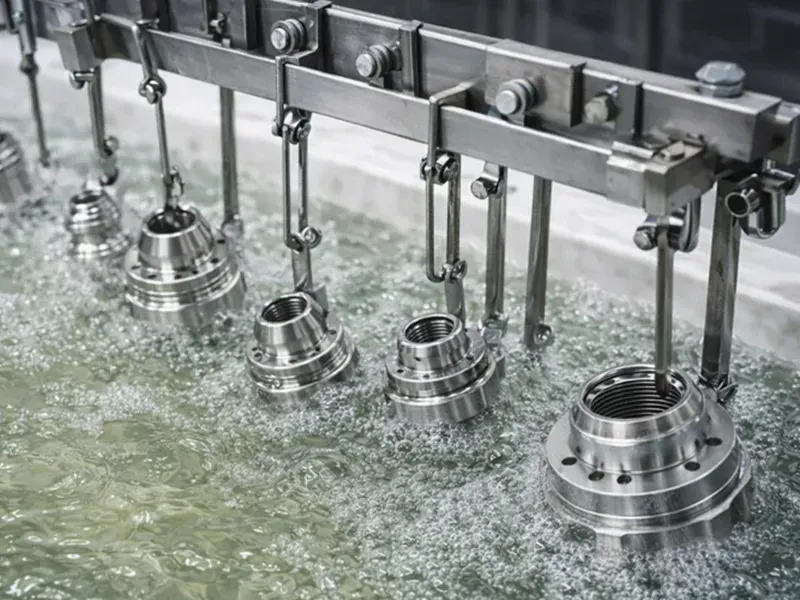
What is Electropolishing & The Science of Surface Perfection
Electropolishing is a specialized electrochemical process that selectively removes material from a metal surface—primarily stainless steel—to create microscopic smoothness and chemical purity. Unlike mechanical polishing, which can smear or contaminate the surface, electropolishing dissolves high points on the metallic profile. This results in a featureless, stress-free surface essential for mission-critical applications in medical devices, food processing, and high-purity semiconductor equipment.
Degreasing & Surface Activation
Raw metal components undergo ultrasonic degreasing and alkaline cleaning to eliminate residual oils and manufacturing contaminants. This critical preparation ensures the electrolyte can interact uniformly with the substrate, preventing “ghosting” or uneven material removal during the electrochemical phase.
Selective Anodic Dissolution
Parts are submerged in a temperature-controlled electrolyte bath and subjected to a regulated DC current. As the anode, the metal surface experiences selective dissolution where microscopic peaks are removed faster than valleys. This process levels the surface profile, eliminates micro-burrs, and creates a high-luster finish even on complex internal geometries.
Chemical Passivation & Neutralization
Following the electrolytic bath, components are thoroughly rinsed and treated with specialized neutralizing agents. This step stabilizes the surface chemistry by maximizing the chromium-to-iron ratio, forming a robust, non-reactive oxide layer that provides superior corrosion resistance and ensures total biocompatibility.
Micro-Surface Metrology & QA
Every batch is verified using precision profilometers to measure surface roughness (Ra) and ensure compliance with sub-micron specifications. Our quality assurance includes visual inspections under high magnification and rigorous testing to guarantee that the surface integrity meets IATF 16949, RoHS, and REACH standards.
Engineered Electropolishing Specifications & Capabilities
Kravzik delivers ultra-precise electrolytic polishing with micron-level process control. Our capabilities are engineered to meet the stringent surface integrity, sterilization, and friction-reduction requirements of medical implants, semiconductor fluid systems, and high-purity aerospace components.
Request DFM EvaluationMaterial Compatibility
300 & 400 Series Stainless Steel, Nitinol, Titanium, Aluminum, and specialty Copper alloys.
Surface Roughness Control
Up to 50% improvement over initial surface; achieving finishes as low as 0.05μm (2 micro-inches).
Dimensional Precision
Controlled removal from 0.0001” to 0.0015” (2.5 – 38 μm) with ±0.0001” repeatability.
Compliance & Standards
Fully compliant with ASTM B912 (Electropolishing), ASTM A967 (Passivation), and IATF 16949 protocols.
Corrosion Performance
Exceeds 500+ hours (ASTM B117); maximizes chromium-to-iron surface ratio for ultimate chemical stability.
Processing Capacity
Automated lines and custom racking for components up to 1200mm x 800mm x 500mm.
Compatible Material Substrates for Precision Electropolishing
The efficacy of electropolishing is deeply rooted in the metallurgical composition of the base metal. At Kravzik, our engineers customize electrolyte chemistry, current density, and thermal parameters to address the unique dissolution rates and surface characteristics of diverse alloys, ensuring superior passivation and sub-micron smoothness for mission-critical applications.
Austenitic Stainless Steel (304, 316L, 317)
The gold standard for medical, pharmaceutical, and food-grade components. Electropolishing these grades maximizes the chromium-to-iron ratio, creating an ultra-passive surface. We utilize high-purity phosphoric-sulfuric baths to achieve a “true” mirror finish (Ra < 0.1μm), ensuring total biocompatibility and eliminating sites for bacterial growth or particulate entrapment.
Martensitic & Ferritic Stainless (410, 420, 440C)
Commonly utilized for high-hardness surgical instruments and precision cutting tools. These high-carbon alloys are prone to “frosting” or uneven etching if current is not meticulously regulated. Our proprietary pulse-current techniques and specialized cooling systems prevent overheating, ensuring a bright, deburred edge without compromising the material’s structural temper or hardness.
Precipitation Hardening Steel (17-4 PH, 15-5 PH)
Engineered for high-stress aerospace and robotics components. The complex microstructure of PH steels requires aggressive pre-treatment descaling to remove heavy heat-treat oxides. We implement a multi-stage activation process that ensures uniform material removal across the entire geometry, providing a defect-free surface that enhances fatigue life and corrosion resistance.
Nitinol (Nickel-Titanium Shape Memory Alloys)
Critical for cardiovascular stents and advanced medical actuators. Nitinol is extremely sensitive to thermal shifts and chemical imbalances. Kravzik employs chilled, non-aqueous electrolyte systems and precision micro-racking to remove the “black oxide” layer and micro-burrs, preserving the alloy’s shape memory properties while achieving a flawless, biocompatible finish.
Titanium & Titanium Alloys (Grade 2, Ti-6Al-4V)
The primary choice for orthopedic implants and aerospace fasteners. Titanium’s high reactivity requires a specialized electrochemical approach to prevent rapid oxidation. We use custom-formulated, low-water electrolytes and constant-voltage monitoring to achieve high-gloss deburring and surface smoothing, meeting the most stringent ASTM F86 requirements for surgical implants.
Specialty Nickel Alloys (Inconel, Monel, Hastelloy)
Designed for extreme environments in oil & gas and chemical processing. These “superalloys” exhibit high resistance to chemical dissolution. Our engineers deploy high-energy electrolytic protocols and specific catalytic additives to overcome material inertia, ensuring deep-pore cleaning and a uniform surface profile that prevents stress corrosion cracking in aggressive media.
Essential Design Guidelines for Precision Electropolishing
Proactive design optimization ensures dimensional accuracy and optimal surface integrity. Consider these critical geometric and electrolytic factors before finalizing your CAD models for the electropolishing process to prevent production delays and ensure your components meet exact engineering specifications.
Unlike plating or coating processes that add material, electropolishing is a subtractive process that removes a controlled layer of surface metal. Typically, this removal ranges from 0.0002” to 0.0015” (5 to 38 µm) per surface. Engineers must adjust their pre-processing tolerances to account for this stock removal, particularly on high-precision mating surfaces and fine-pitch threads to ensure perfect final assembly.
Electrochemical dissolution occurs more rapidly at sharp corners and external edges due to high current density concentration. This naturally results in a slight “rounding” or deburring effect. If sharp edges are critical for functional performance, we recommend specifying specialized cathode shielding or adjusting the design with generous radii to ensure uniform material removal across the entire profile.
Deep blind holes, narrow channels, and complex internal diameters are subject to the “Faraday Cage” effect, where electrical current—and thus material removal—is significantly reduced. For components requiring a high-purity internal finish, Kravzik utilizes custom-engineered auxiliary cathodes. Proactive design including through-holes or increased access diameters can greatly improve electrolyte flow and finish consistency.
As an electrochemical process, every part must be securely fixtured to a rack to provide the necessary DC current. This will leave small, localized “witness marks” where the contact occurs. Please identify non-critical or hidden surfaces on your technical drawings where these contact points can be placed to maintain the aesthetic and functional integrity of your primary surfaces.
The electropolishing bath requires total immersion and constant fluid exchange. Parts with “cupped” features or trapped air pockets can cause gas streaking or chemical spotting. Design your components with adequate drainage pathways and air-bleed holes to ensure the electrolyte reaches all surfaces and that oxygen gas generated during the process can escape freely.
VISUAL EXCELLENCEData-Driven Showcase: Engineered Electropolishing Finishes
Beyond visual brilliance, electropolishing provides critical functional advantages including microscopic smoothness and total surface passivation. Explore our standard processing profiles to determine the precise surface integrity and roughness specifications required for your mission-critical assembly.
SURFACE INTEGRITY LEVELHigh-Luster Mirror Electropolishing
BiocompatibleRa < 0.1μmSanitary GradeHigh ReflectivityUtilizing high-concentration electrolytes and precise current density, this process achieves maximum microscopic leveling. It eliminates surface inclusions and creates a featureless, non-stick surface that prevents bacterial adhesion and particulate entrapment.
Typical RoughnessRa 0.05 – 0.15 μm (2 - 6 micro-inches)Material Removal0.0005” – 0.0015” (12 - 38 μm)Corrosion ResistanceExceptional (ASTM B117 500+ Hours)Primary BenefitMaximum sterilization efficiency and zero particulate entrapmentIdeal For:Surgical implants, semiconductor gas valves, food-grade bladesCHEMICAL STABILIZATION LEVELSatin / Matte Functional Finish
Chemical StabilityBurr-FreeStress-RelievedUniform SatinOptimized for functional performance over pure aesthetics, this profile focuses on deep chemical cleaning and oxide layer stabilization. It provides a clean, uniform satin appearance while ensuring the surface is entirely free of free-iron contamination and manufacturing stresses.
Typical Roughness30% – 50% Ra reduction from base materialMaterial Removal0.0002” – 0.0005” (5 - 13 μm)Surface ChemistryHigh Chromium-to-Iron (Cr:Fe) ratio (> 2:1)Primary BenefitSuperior resistance to localized pitting and crevice corrosionIdeal ForAerospace fasteners, robotic chassis, industrial manifoldsPRECISION COMPONENT LEVELEngineered Micro-Deburring
Internal CleaningIntricate PartsEdge ControlNon-DistortingSpecially engineered for complex internal diameters and micro-machined parts. Using custom auxiliary cathodes, we ensure uniform material removal in deep recesses that mechanical methods cannot reach, providing precise edge smoothing without altering critical bulk dimensions.
Feature SizeEffective on internal diameters down to 0.5mmTolerance Control±0.0001” (2.5 μm) process repeatabilitySurface Purity100% Free of embedded abrasives or contaminantsPrimary BenefitTotal elimination of micro-burrs in critical fluid pathsIdeal ForFuel injection nozzles, micro-surgical tools, capillary tubes Request DFM EvaluationView Surface Treatment SolutionsSERVICES LIBRARYExplore Other Industrial Surface Treatment & Finishing Services Available
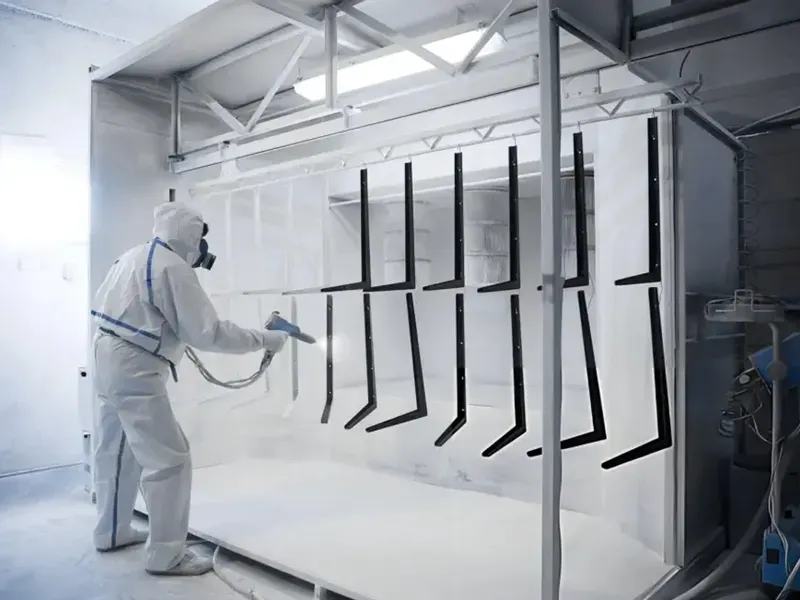
Powder Coating
Eliminate surface defects like orange peel on complex geometries. Our automated lines guarantee 1000h salt spray resistance for heavy-duty industrial components.
Learn More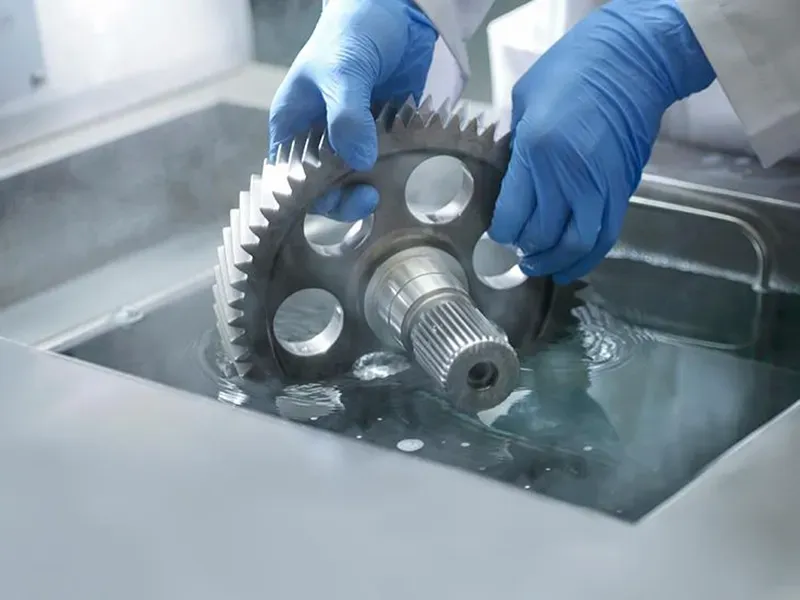
Degreasing
Eliminate microscopic contaminants that ruin precision plating. Achieve >40 dynes/cm surface energy for flawless secondary processing.
Learn More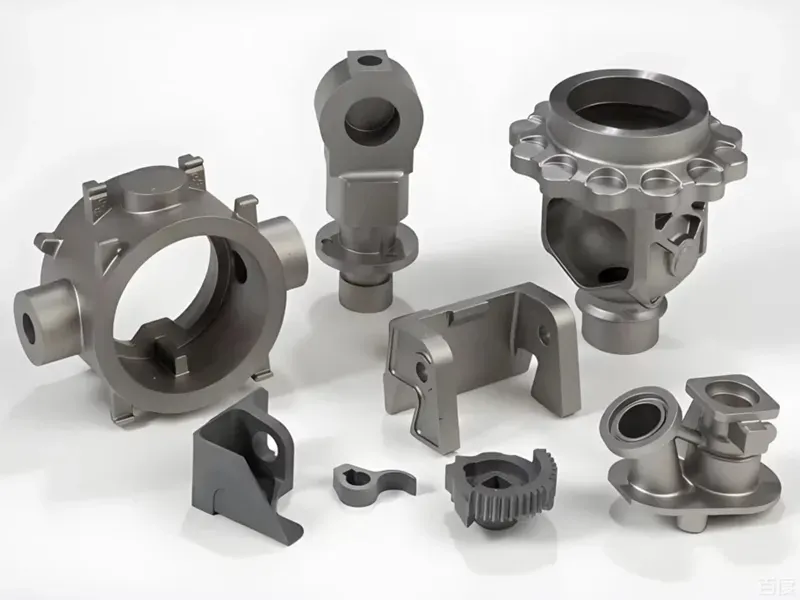
Nitriding
Forget brittle surfaces and dimensional warping. Kravzik delivers 1200 HV surface hardness while maintaining absolute ±5µm geometric precision.
Learn MoreRequest DFM EvaluationSee More Surface TreatmentTECHNICAL REFERENCEFrequently Asked Questions
Answers to common questions regarding precision, tooling, materials, and our integrated molding capabilities.Yes, our advanced electrolyte control consistently achieves finishes as low as 0.05 microns Ra on 300-series stainless steel, meeting the most stringent semiconductor and medical industry standards.
We utilize precision DC power regulation to limit material removal to within 0.0001 inches, ensuring high-precision metal stamping and CNC parts maintain critical assembly dimensions after processing.
In addition to all stainless steel grades, Kravzik provides specialized electropolishing for Nitinol, Titanium, Aluminum, and Nickel-based superalloys like Inconel for high-performance aerospace and medical applications.
By designing custom auxiliary cathodes, we overcome the Faraday Cage effect, allowing for uniform material removal and total deburring in deep bores and intricate internal channels that mechanical tools cannot reach.
Absolutely. Electropolishing removes the surface iron layer much more deeply than chemical passivation, maximizing the chromium-to-iron ratio and providing up to 30 times more protection against localized pitting.
Yes, our facility operates under a rigorous IATF 16949-level quality management system, providing the full documentation, traceability, and process repeatability required for the critical automotive and medical sectors.
Our process is fully biocompatible, removing all surface inclusions and microscopic contaminants to create a non-pyrogenic, sterile-ready surface that exceeds ASTM B912 and international surgical grade requirements.
We offer rapid-turnaround prototype electropolishing services, helping your engineering team validate surface roughness and dimensional changes on custom stamped or molded parts before proceeding to high-volume production.

Still have questions?
Our engineering team loves solving complex problems. Chat with us or send your drawing for a review.
Request DFM EvaluationReady to Manufacture With One Accountable Factory?
From in-house tooling to high-volume production — stamping, molding, plating and assembly under one IATF 16949 roof. Send your spec and volume, get a quote within 24 hours.